
Online Session on “Why Data Privacy Matters for MSMEs, Startups and SMEs”
Understanding the DPDP Act 2023, Business Risks, Responsibilities and Practical Steps Towards Compliance
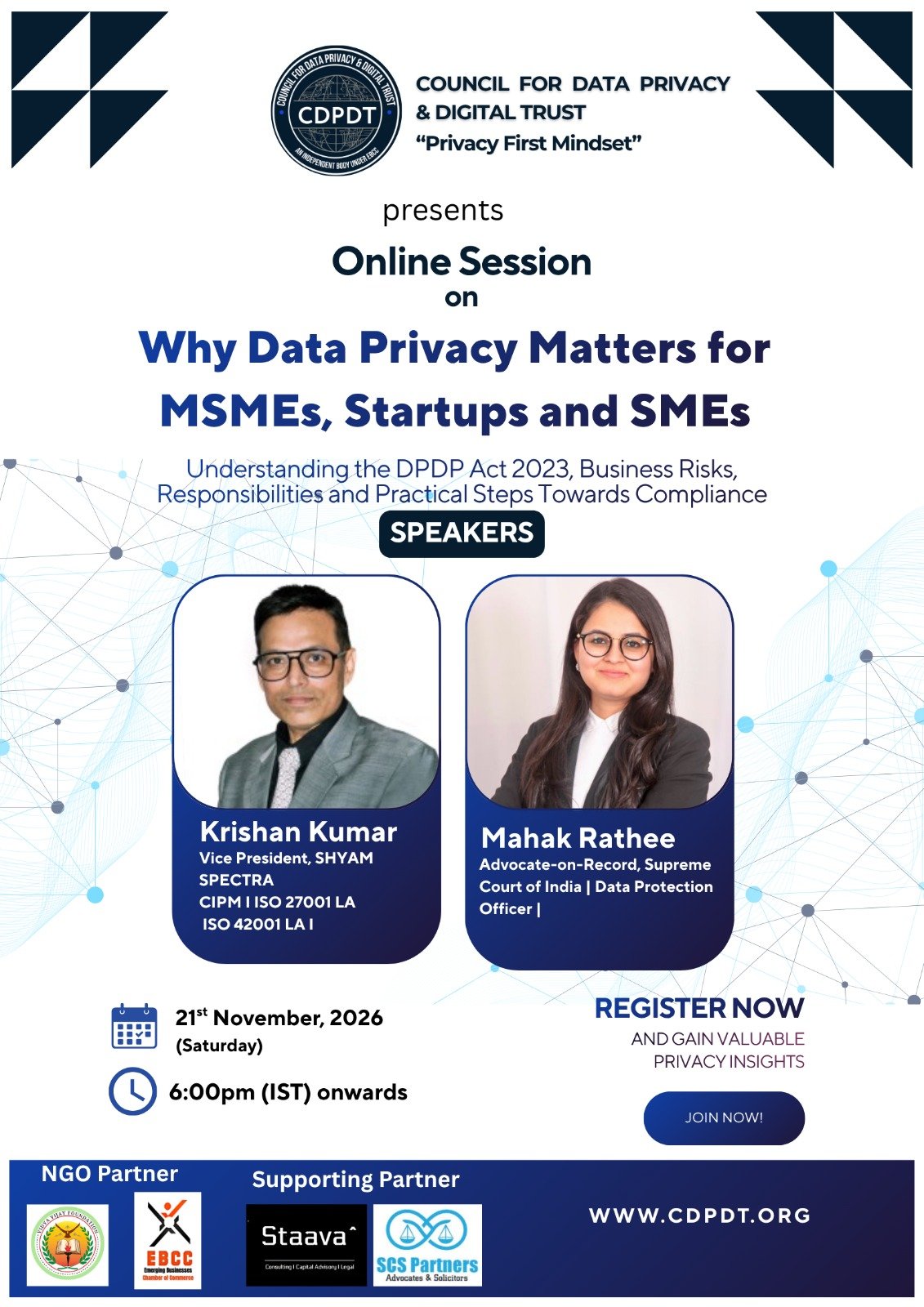
Organised by: Council for Data Privacy & Digital Trust (CDPDT), an independent body under EBCC NGO Partner: Vidya Vijay Foundation; Emerging Businesses Chamber of Commerce (EBCC) Supporting Partners: Staava; SCS Partners, Advocates & Solicitors
Event at a Glance
| Format | Online session (webinar) |
| Date | Saturday, 21 November 2026 |
| Time | 6:00 pm IST onwards |
| Speakers | Krishan Kumar, Mahak Rathee |
| Audience | Founders, MSME owners, startup teams, SME leadership, compliance and IT personnel |
| Registration | Via the “Join Now” link on the event poster / www.cdpdt.org |
- Background
India’s digital economy runs on personal data. Even the smallest business today collects customer phone numbers, employee records, payment details, KYC documents and marketing leads, often through WhatsApp, spreadsheets, cloud tools and third-party apps. With the enactment of the Digital Personal Data Protection (DPDP) Act, 2023, handling this data is no longer just a matter of good practice. It is a legal responsibility.
MSMEs, startups and SMEs form the backbone of the Indian economy, yet they are often the least prepared for data protection obligations. Limited budgets, no dedicated legal or IT security teams, and a belief that privacy law applies only to large technology companies leave many of them exposed. A data breach, a complaint from a customer, or a lost enterprise client due to weak privacy practices can cause serious financial and reputational damage to a small business.
The Council for Data Privacy & Digital Trust (CDPDT), guided by its “Privacy First Mindset”, is organising this session to help smaller businesses understand why privacy matters to them and what they can realistically do about it.
- Rationale
- Legal exposure: The DPDP Act applies to any entity processing digital personal data, regardless of size, and carries significant financial penalties for non-compliance, including for failure to maintain reasonable security safeguards.
- Awareness gap: Many small businesses are unaware that they are “Data Fiduciaries” under the Act, or that they have duties around consent, notice, purpose limitation, data accuracy, retention and breach reporting.
- Business value: Strong privacy practices build customer trust, help win enterprise and export clients who demand compliance from their vendors, and improve investor confidence during due diligence.
- Practicality: Compliance for a small business must be proportionate, affordable and phased. It needs clear, jargon-free guidance rather than heavy legal theory.
- Objectives
By the end of the session, participants will be able to:
- Understand the core framework of the DPDP Act 2023 and its associated Rules, and why it applies to them.
- Recognise the key roles and terms: Data Principal, Data Fiduciary, Data Processor, Significant Data Fiduciary and Data Protection Officer.
- Identify the business, legal, operational and reputational risks of non-compliance.
- Understand their core responsibilities, including notice and consent, security safeguards, breach notification, children’s data, and the rights of individuals.
- Take away a practical, step-by-step roadmap to begin their compliance journey with limited resources.
- Learn where to find further support, tools and expert guidance.
- Proposed Session Outline
| Segment | Content |
| Welcome and context | Introduction to CDPDT, the session purpose and the speakers |
| Why privacy matters for small businesses | Data as a business asset and a liability; real-world breach scenarios affecting MSMEs and startups |
| The DPDP Act 2023 explained | Key definitions, scope, principles, rights of Data Principals, duties of Data Fiduciaries, penalties and enforcement through the Data Protection Board |
| Business risks and responsibilities | Common gaps: informal data handling, vendor and cloud dependencies, employee data, marketing and customer databases, absence of consent records |
| Practical steps towards compliance | Data mapping, privacy notice and consent mechanisms, security controls, vendor contracts, breach response plan, retention and deletion, training, and when to appoint a DPO |
| Interactive Q&A | Participant questions to the speakers |
| Closing | Key takeaways, resources and next steps |
- Key Themes for Discussion
- Does the DPDP Act apply to my business? What data am I actually processing?
- Consent, notice and lawful use: getting the basics right
- Reasonable security safeguards on a startup budget
- Handling vendors, cloud platforms and outsourced processors
- Preparing for a data breach and the obligation to report
- Privacy as a competitive advantage in sales, funding and partnerships
- Emerging considerations, including the link between data privacy and responsible AI governance
Speakers
Krishan Kumar, Vice President, SHYAM SPECTRA. Certified in CIPM, ISO 27001 Lead Auditor and ISO 42001 Lead Auditor. He brings an implementation and information-security perspective on building privacy and governance practices inside organisations.
Mahak Rathee, Advocate-on-Record, Supreme Court of India, and Data Protection Officer. She brings the legal and regulatory perspective on the DPDP Act, obligations and enforcement.
- Target Audience
- Founders and co-founders of startups
- Owners and managers of MSMEs and SMEs
- Senior management, HR, marketing, finance and IT heads in small and mid-sized businesses
- Compliance officers, legal consultants, chartered accountants and company secretaries advising small businesses
- Members of industry chambers and associations, and students interested in data privacy
- Expected Outcomes
- Greater awareness of DPDP obligations among small businesses
- A clear, practical starting checklist that participants can apply immediately
- Stronger connections between businesses, legal experts and privacy professionals
- A step towards building a culture of privacy and digital trust in India’s MSME and startup ecosystem.
Register Now